Start with the whole work zone
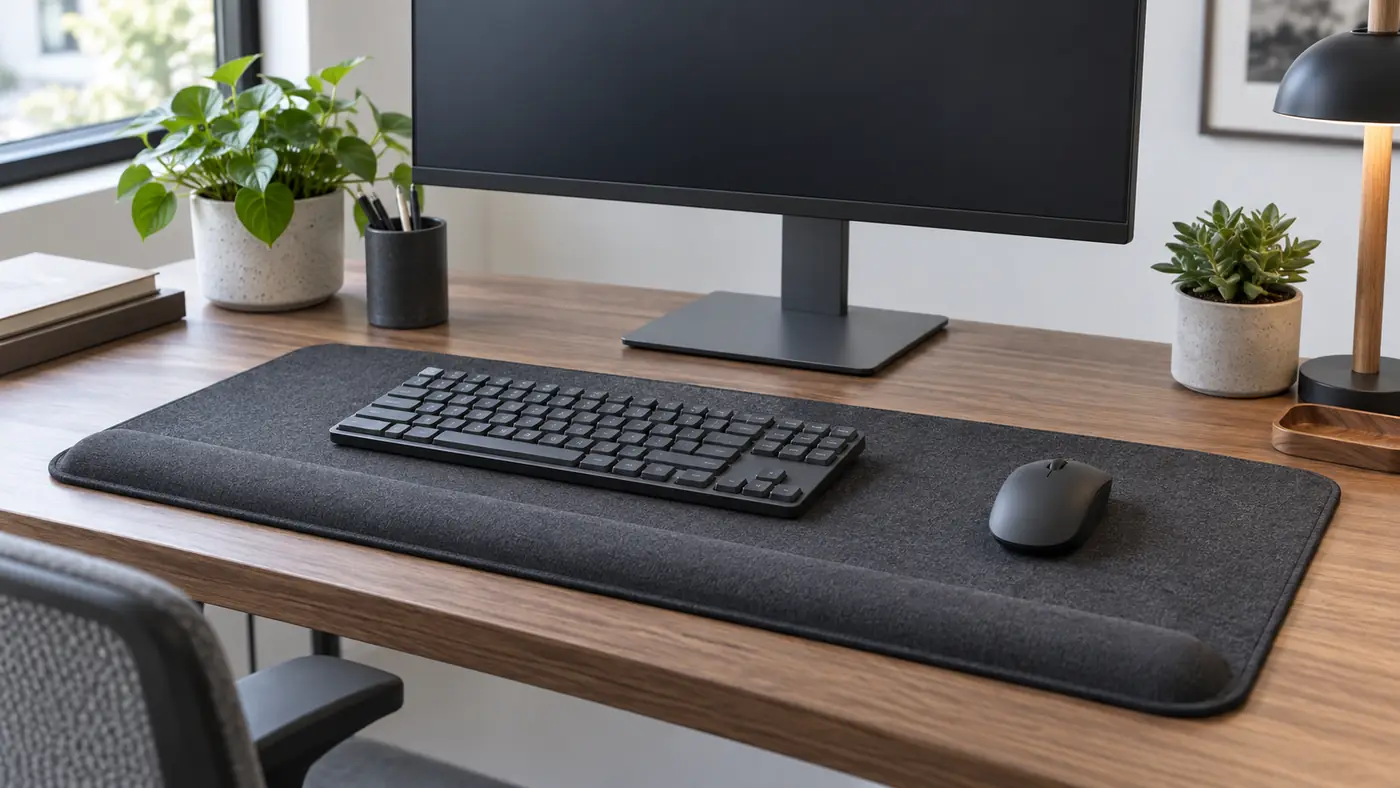
Begin with the desk as it is used. An extended desk mat changes more than the amount of covered desktop; it sets a common plane for keyboard, mouse, notes and support. For a useful product-level reference, consult this extended gel-wrist-support comparison, then return to the wider layout choices described here. Measure the clear usable rectangle after the keyboard, display stand, charging cable and drink have taken their honest share. The source is one input; the desk geometry still decides whether a setup has enough room.
Lay out the occupied desktop before treating any soft surface as the answer. Measure the clear usable rectangle after the keyboard, display stand, charging cable and drink have taken their honest share. The observation is stronger when it is repeated during a representative task rather than inferred from a single still position. The desk plan becomes credible when it includes the inconvenient objects that arrive during real work.
Lay out the occupied desktop before treating any soft surface as the answer. Mark the route used for ordinary pointing, wide selection and an occasional drag before deciding that a wrist rest belongs inside it. Compare the current condition with one modest alternative so the change has a clear cause and a clear consequence. The desk plan becomes credible when it includes the inconvenient objects that arrive during real work.
Lay out the occupied desktop before treating any soft surface as the answer. Do not treat a long mat as permission to fill every edge; empty travel room is part of the ergonomic benefit. If the adjustment improves one activity while adding a new obstacle elsewhere, keep both outcomes in the notes before deciding what to retain. The desk plan becomes credible when it includes the inconvenient objects that arrive during real work.
Lay out the occupied desktop before treating any soft surface as the answer. The result is a deliberate mousing corridor rather than a handsome but cramped arrangement. A useful conclusion remains specific enough that another person can test it while allowing their different reach, task mix and equipment. The desk plan becomes credible when it includes the inconvenient objects that arrive during real work.
Use the support as a pause point, not a lever
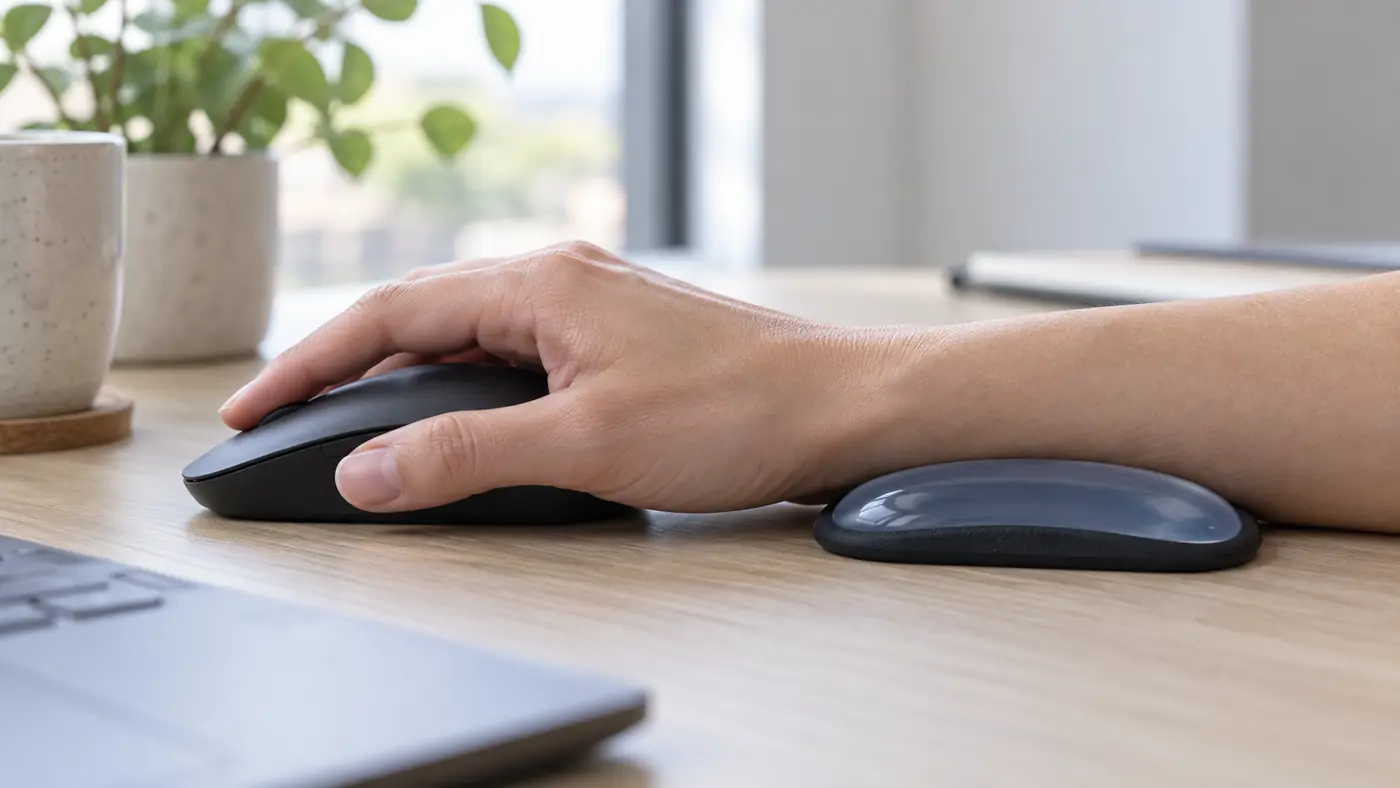
A support cannot be judged in a vacuum; its value depends on the approach to the mouse. A gel rest is most useful when it gives the heel of the hand a brief landing zone between movements, not when it bears force during every glide. Read that detail against the layout you use on an ordinary day, including the objects and movements that do not appear in a staged desk scene. That is why the hand, forearm and pointer should be observed as one linked route.
A support cannot be judged in a vacuum; its value depends on the approach to the mouse. Watch whether the wrist bends upward, presses into the front edge, or stops the mouse before the forearm can move. The observation is stronger when it is repeated during a representative task rather than inferred from a single still position. That is why the hand, forearm and pointer should be observed as one linked route.
A support cannot be judged in a vacuum; its value depends on the approach to the mouse. Compare the relationship between the mouse top, pad thickness and support crest while the chair and elbow height remain ordinary. Compare the current condition with one modest alternative so the change has a clear cause and a clear consequence. That is why the hand, forearm and pointer should be observed as one linked route.
A support cannot be judged in a vacuum; its value depends on the approach to the mouse. A very tall cushion can turn a small mismatch into shoulder tension, so comfort should be judged across a normal hour rather than one posed moment. If the adjustment improves one activity while adding a new obstacle elsewhere, keep both outcomes in the notes before deciding what to retain. That is why the hand, forearm and pointer should be observed as one linked route.
A support cannot be judged in a vacuum; its value depends on the approach to the mouse. This makes support height a setup variable that can be adjusted or rejected without blaming the user. A useful conclusion remains specific enough that another person can test it while allowing their different reach, task mix and equipment. That is why the hand, forearm and pointer should be observed as one linked route.
Protect room for forearm movement
Broad arm movement is often quieter than a repeated wrist correction at the edge of its range. The mouse is guided by the hand, but its practical range is shaped by the forearm, elbow and the point where the arm meets the desk. Read that detail against the layout you use on an ordinary day, including the objects and movements that do not appear in a staged desk scene. The useful layout lets those parts of the arm share the job instead of isolating one joint.
Broad arm movement is often quieter than a repeated wrist correction at the edge of its range. Notice whether the elbow has a neutral place near the body or keeps drifting outward to clear the keyboard corner. The observation is stronger when it is repeated during a representative task rather than inferred from a single still position. The useful layout lets those parts of the arm share the job instead of isolating one joint.
Broad arm movement is often quieter than a repeated wrist correction at the edge of its range. Position the mouse so routine travel happens from the arm and shoulder in small shared motions instead of forcing the wrist to make every correction. Compare the current condition with one modest alternative so the change has a clear cause and a clear consequence. The useful layout lets those parts of the arm share the job instead of isolating one joint.
Broad arm movement is often quieter than a repeated wrist correction at the edge of its range. Avoid a layout that demands a fixed elbow; bodies shift during reading, calls and focused editing. If the adjustment improves one activity while adding a new obstacle elsewhere, keep both outcomes in the notes before deciding what to retain. The useful layout lets those parts of the arm share the job instead of isolating one joint.
Broad arm movement is often quieter than a repeated wrist correction at the edge of its range. A low-pressure zone leaves enough space for movement to vary while the controls remain predictable. A useful conclusion remains specific enough that another person can test it while allowing their different reach, task mix and equipment. The useful layout lets those parts of the arm share the job instead of isolating one joint.
Check surface behavior before speed
Surface decisions deserve a repeatable task rather than a quick swipe across a new mat. Texture affects how much effort begins a motion, how abruptly it stops, and whether the skin catches at the edge of the working area. Read that detail against the layout you use on an ordinary day, including the objects and movements that do not appear in a staged desk scene. A comparison has value when the mouse, software setting and work target stay comparable.
Surface decisions deserve a repeatable task rather than a quick swipe across a new mat. Test short precision motions, a long diagonal move and a return to the starting point with the software sensitivity left unchanged. The observation is stronger when it is repeated during a representative task rather than inferred from a single still position. A comparison has value when the mouse, software setting and work target stay comparable.
Surface decisions deserve a repeatable task rather than a quick swipe across a new mat. Use the same mouse and task for each comparison so a rough surface is not being judged against a different device setting. Compare the current condition with one modest alternative so the change has a clear cause and a clear consequence. A comparison has value when the mouse, software setting and work target stay comparable.
Surface decisions deserve a repeatable task rather than a quick swipe across a new mat. No surface is automatically better for every person; the useful choice is the one that permits control without a gripping response. If the adjustment improves one activity while adding a new obstacle elsewhere, keep both outcomes in the notes before deciding what to retain. A comparison has value when the mouse, software setting and work target stay comparable.
Surface decisions deserve a repeatable task rather than a quick swipe across a new mat. That test turns vague claims about glide into an observation someone can repeat at their own desk. A useful conclusion remains specific enough that another person can test it while allowing their different reach, task mix and equipment. A comparison has value when the mouse, software setting and work target stay comparable.
Give the keyboard its own boundary
Keyboard placement is a geometric decision with a direct effect on mouse-side reach. An extended mat can make keyboard and mouse look like one object, yet their reach requirements are different and should stay visible. Read that detail against the layout you use on an ordinary day, including the objects and movements that do not appear in a staged desk scene. Fix the object that is consuming space before asking a cushion to conceal the consequence.
Keyboard placement is a geometric decision with a direct effect on mouse-side reach. Look for a keyboard angle or number-pad width that pushes the mouse beyond a relaxed line from the elbow. The observation is stronger when it is repeated during a representative task rather than inferred from a single still position. Fix the object that is consuming space before asking a cushion to conceal the consequence.
Keyboard placement is a geometric decision with a direct effect on mouse-side reach. Shift, narrow or temporarily remove accessories before moving the mouse farther away; the nearest crowded object often causes the problem. Compare the current condition with one modest alternative so the change has a clear cause and a clear consequence. Fix the object that is consuming space before asking a cushion to conceal the consequence.
Keyboard placement is a geometric decision with a direct effect on mouse-side reach. Do not use the wrist support to compensate for a keyboard that has already displaced the pointer too far from the body. If the adjustment improves one activity while adding a new obstacle elsewhere, keep both outcomes in the notes before deciding what to retain. Fix the object that is consuming space before asking a cushion to conceal the consequence.
Keyboard placement is a geometric decision with a direct effect on mouse-side reach. Separating these decisions keeps the mouse zone from inheriting the keyboard’s compromises. A useful conclusion remains specific enough that another person can test it while allowing their different reach, task mix and equipment. Fix the object that is consuming space before asking a cushion to conceal the consequence.
Make shared use measurable
A common desk needs a recoverable baseline, not a declaration that one user has the correct posture. A desk used by more than one person needs reference marks and a quick reset sequence, not a claim that one position suits everyone. Read that detail against the layout you use on an ordinary day, including the objects and movements that do not appear in a staged desk scene. Small markers and short reset steps keep shared decisions visible without making them rigid.
A common desk needs a recoverable baseline, not a declaration that one user has the correct posture. Record chair height, mouse-side clearance and preferred support placement with unobtrusive landmarks that survive routine cleaning. The observation is stronger when it is repeated during a representative task rather than inferred from a single still position. Small markers and short reset steps keep shared decisions visible without making them rigid.
A common desk needs a recoverable baseline, not a declaration that one user has the correct posture. Let each person change the support position and cursor speed without treating those choices as a failure of the shared setup. Compare the current condition with one modest alternative so the change has a clear cause and a clear consequence. Small markers and short reset steps keep shared decisions visible without making them rigid.
A common desk needs a recoverable baseline, not a declaration that one user has the correct posture. Avoid permanent adhesive or a large fixed rest when the desk must switch between left- and right-handed use. If the adjustment improves one activity while adding a new obstacle elsewhere, keep both outcomes in the notes before deciding what to retain. Small markers and short reset steps keep shared decisions visible without making them rigid.
A common desk needs a recoverable baseline, not a declaration that one user has the correct posture. The practical aim is a setup that can be restored in minutes and still respects different reach patterns. A useful conclusion remains specific enough that another person can test it while allowing their different reach, task mix and equipment. Small markers and short reset steps keep shared decisions visible without making them rigid.
| Desk signal | Useful response |
|---|---|
| Mouse begins far from elbow | Check keyboard footprint before enlarging reach |
| Wrist meets a tall ridge | Reassess support height and its distance from the mouse |
| Mat edge catches the forearm | Inspect perimeter finish and travel direction |
| Surface feels sticky after cleaning | Let it dry fully and reconsider the cleaning method |
Review wear before it becomes a posture problem
Materials quietly change the system as they flatten, curl, collect debris or lose grip. Gel, fabric and edge binding change over time, which means a once-suitable work surface can slowly introduce pressure or drag. Read that detail against the layout you use on an ordinary day, including the objects and movements that do not appear in a staged desk scene. A short inspection turns that change into evidence before it becomes a source of irritation.
Materials quietly change the system as they flatten, curl, collect debris or lose grip. Inspect for a split seam, flattened crest, sticky coating, curled corner or debris that changes the mouse path. The observation is stronger when it is repeated during a representative task rather than inferred from a single still position. A short inspection turns that change into evidence before it becomes a source of irritation.
Materials quietly change the system as they flatten, curl, collect debris or lose grip. Clean with the method appropriate to the materials and let the surface dry fully before judging the glide again. Compare the current condition with one modest alternative so the change has a clear cause and a clear consequence. A short inspection turns that change into evidence before it becomes a source of irritation.
Materials quietly change the system as they flatten, curl, collect debris or lose grip. Replacement is sensible when the support no longer holds its shape or when cleaning cannot remove a tacky, uneven contact area. If the adjustment improves one activity while adding a new obstacle elsewhere, keep both outcomes in the notes before deciding what to retain. A short inspection turns that change into evidence before it becomes a source of irritation.
Materials quietly change the system as they flatten, curl, collect debris or lose grip. A short recurring inspection protects the working geometry better than waiting for discomfort to announce a failure. A useful conclusion remains specific enough that another person can test it while allowing their different reach, task mix and equipment. A short inspection turns that change into evidence before it becomes a source of irritation.

Before you call the zone finished
- Can the mouse complete ordinary and wide movements without hitting another object?
- Does the support permit a neutral approach rather than becoming a fixed ridge?
- Does the keyboard leave reasonable mouse-side reach for your actual work?
- Can the surface be cleaned and inspected without disrupting the entire desk?
- Can a shared user restore the common layout without guessing?